


Diamonds
Engagement
Bridal
Jewelry
Education
We're here to help
Real people, ready to help you find the perfect diamond or piece of jewelry.
Call usMon–Fri, 9 AM – 12 AM EST1‑866‑522‑2539 › Email usDrop us a note — we reply within 24 hours[email protected] ›Education
Your guide to becoming a jewelry expert
Diamond Cut
Cut is the basic facet arrangement of a diamond. It is the only attribute a human can modify — unlike color and clarity — as it decides how a light ray will enter and be refracted from a diamond.
The finer the cut, the more brilliant the diamond's shine and the higher its value. It is one of the most important criteria for judging a diamond's value, as it directly affects appearance.
Brilliance, Polish and Symmetry
The cut of a diamond affects its brilliance (reflection of light), whereas polish (smoothness of facets) and symmetry (alignment of facets) affect the sparkle of a diamond. A poor polish can make a diamond look dull, and poor symmetry can misdirect the light, reducing the sparkle.
Types of Cut
There are three types of cuts, as shown below:

Shallow Cut
Light refracts away through the bottom.

Ideal Cut
Light gets reflected through the top, producing maximum brilliance.

Deep Cut
Light refracts away through the sides.
GIA Cut Grading
Diamond cuts are graded on the following scale established by the Gemological Institute of America (GIA):
- Excellent Cut: The rarest cut grade of all, an Excellent cut reflects the maximum light entering the diamond and thus shines with optimum brilliance.
- Very Good Cut: A Very Good cut grade may cost less than the Excellent cut, but it is equally beautiful and brilliant.
- Good Cut: A Good cut grade helps reflect light to obtain a good amount of brilliance, though not equal to Excellent or Very Good. Thus it demands a much lower price.
- Fair Cut: Not as brilliant as a Good cut, Fair cut grade diamonds refract less light, but make a better choice than Poor cut diamonds.
Diamond Dimensions
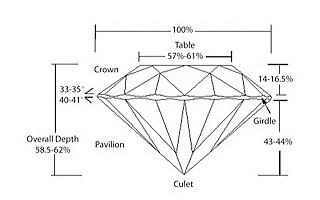
The various dimensions of a diamond are defined as follows:
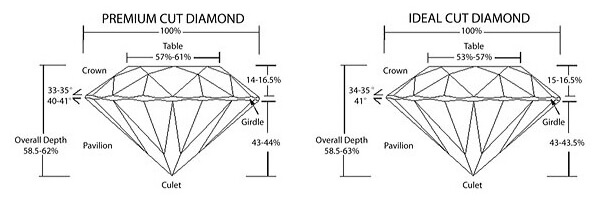
- Table: The topmost and largest facet of a diamond.
- Crown: The sloping section of a diamond — from the girdle to the table.
- Girdle: The point where the crown and pavilion meet, which also determines the perimeter of the diamond.
- Diameter: The width of the diamond measured with reference to the girdle.
- Pavilion: The lower section of a diamond, from the girdle to the culet.
- Culet: The tip of a diamond (the best culet is invisible to the naked eye).
- Depth: The height of a diamond measured from the culet to the table.
B2C Jewels' Ideal Cut Grade
If you want to buy a diamond with utmost brilliance, an Excellent cut grade is a suitable option with good polish and symmetry.
However, if budget is a concern, a diamond with good polish and symmetry and an Excellent or Very Good cut can be chosen in G–H color and SI1 or SI2 clarity.
B2C Jewels offers a wide range of loose diamonds with Excellent, Very Good, Good and Fair cut, selectable according to your choice.
Lifetime warranty · free insured shipping · 30-day returns
Certified Natural & Lab-Grown Diamonds and Fine Jewelry Since 2004
B2C Jewels is a trusted online jeweler for certified natural diamonds and lab-grown diamonds, each independently GIA- or IGI-graded. Browse thousands of loose diamonds in every shape and price, then set your stone in a handcrafted ring or piece of fine jewelry.
Design a one-of-a-kind engagement ring, shop wedding & anniversary rings, or explore diamond jewelry including earrings, bracelets and pendants & necklaces. New to diamonds? Start with our diamond education guide.
Every order ships free and fully insured, with a 30-day return policy, lifetime upgrade and free resizing — so you can buy certified diamonds online with complete confidence.