


Diamonds
Engagement
Bridal
Jewelry
Education
We're here to help
Real people, ready to help you find the perfect diamond or piece of jewelry.
Call usMon–Fri, 9 AM – 12 AM EST1‑866‑522‑2539 › Email usDrop us a note — we reply within 24 hours[email protected] ›Education
Your guide to becoming a jewelry expert
Types of Pearls
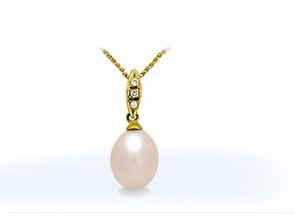
Pearls are said to be the most feminine of gemstones and are considered prized possessions for their innocent beauty and rarity. The existence of pearls dates back more than 4,000 years, yet they still add elegance and sophistication to your appearance today — be it any type of pearl, natural or cultured.
1. Natural Pearls
Natural pearls, as the name suggests, are formed by nature. When a small particle — typically a parasite or organic matter — accidentally becomes embedded in the tissue of an oyster or mollusk, the mantle tissues secrete nacre, and the nacre building up in layers eventually forms a pearl. The formation of a natural pearl is a purely accidental phenomenon. Natural pearls are 100% nacre.
2. Cultured Pearls
Cultured pearls are those formed by the deliberate intervention of man. The process of forming cultured pearls is no different from that of natural pearls, except that here the entrance of a foreign particle is not accidental but intentionally done by man. Culturing of pearls gained momentum as natural pearls are rare to find.
Both natural and cultured pearls can be either freshwater or saltwater pearls:
- a. Freshwater Pearls:
As their name suggests, freshwater pearls find their origin in fresh water bodies such as lakes, rivers, etc. Though the traditional source of pearls has been oysters that live in saltwater, mollusks that live in freshwater can also produce pearls. In general, freshwater pearls are not as round as saltwater pearls and tend to be less expensive. - b. Saltwater Pearls:
The cultivating technique used to obtain saltwater pearls takes about two and a half years, with each oyster giving one pearl. These pearls are therefore more expensive than freshwater pearls and are better in quality because the nacre becomes very thick due to the prolonged period of pearl formation.
Popular Pearls
Given below are a few popular types of pearls majorly used in jewelry-making:
- Akoya Pearls:
When pearls are cultured within an Akoya oyster, usually found in China and Japan, they are called Akoya pearls. White and cream colored pearls are most common, while lighter shades of pink and silver pearls are also available. Akoya pearls are perfectly round in shape and very small in size — around 2mm to 11mm, owing to the small size of the oyster. This consistency of shape favors their use in making jewelry such as stud earrings, bracelets and neckpieces. - Black Tahitian Pearls:
Tahitian pearls are produced by the black-lipped oyster in the islands of French Polynesia. The black-lipped oyster is huge, resulting in much larger pearl formation. Most black Tahitian pearls are rarely pure black. Instead they are silver, charcoal or a multitude of colors, with the dominant color being green. Owing to their rarity and high value, Tahitian pearls make a unique gifting option. - South Sea Pearls:
The formation of South Sea pearls takes place in large culturing areas over an extended growth period. They are generally much larger compared to other pearls and tend to have a deep, velvety luster quality. Silver-lipped oysters normally produce pearls in white, silver, aqua and blue family overtones. The gold-lipped oyster develops overtones in champagne, vanilla and deeper golden varieties. South Sea pearls generally retain the highest value of all pearl types.
Imitation Pearls
Imitation pearls are simply referred to as artificial pearls, i.e. pearls that are not created from oysters. Thus they do not fall under the category of true pearls and are very low in quality due to the difference in weight, smoothness and luster.
The enticing variety available in genuine pearl jewelry is highly commendable at B2C Jewels.
Lifetime warranty · free insured shipping · 30-day returns
Certified Natural & Lab-Grown Diamonds and Fine Jewelry Since 2004
B2C Jewels is a trusted online jeweler for certified natural diamonds and lab-grown diamonds, each independently GIA- or IGI-graded. Browse thousands of loose diamonds in every shape and price, then set your stone in a handcrafted ring or piece of fine jewelry.
Design a one-of-a-kind engagement ring, shop wedding & anniversary rings, or explore diamond jewelry including earrings, bracelets and pendants & necklaces. New to diamonds? Start with our diamond education guide.
Every order ships free and fully insured, with a 30-day return policy, lifetime upgrade and free resizing — so you can buy certified diamonds online with complete confidence.